Fun with ‘bots
I’ve been having an interesting time “conversing” with AI chatbots about water resources issues around here, and what we might be doing about all that. In one of the latest chats, we discussed the situation in the Salado Creek watershed, in Williamson and Bell counties, north of Austin. It turned out to be a good “tutorial” on how developers who are requesting wastewater discharge permits there might be dealt with to deflect them off that strategy, and maybe get them moving to a “One Water” approach. Likely saving money for themselves, while saving water and blunting pollution for society.
The figure below, drawn from the Save Texas Streams website, shows the locations of a number of developments that are presently pursuing permits to discharge the wastewater they would produce into Salado Creek or one of its tributaries. These are predicated on the presumption, we are left to believe, this is the most “efficient” manner in which to “manage” that water resource – except it would not be managed as a resource, it would be managed as a waste, made to “go away” down the creek. With Salado Creek being deemed a “pristine stream” and flowing over the Edwards Aquifer Recharge Zone, environmental advocacy groups, led by Save Texas Streams, are challenging these permits.
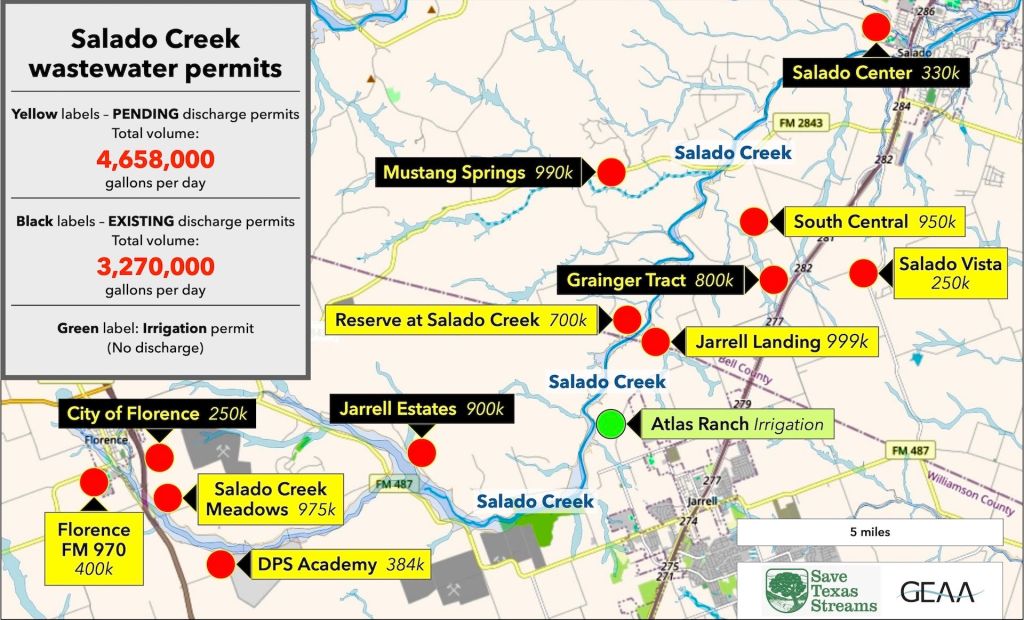
The scale of these discharges range from 250,000 to 999,000 gallons/day of permitted flow. It does seem clear that discharging at such levels, given the water quality limits that TCEQ so far appears willing and able to require here – in particular for the nutrients nitrogen and phosphorus – would degrade the “pristine” stream. And also likely degrade water quality in the aquifers that Salado Creek recharges. So the stakes are real.
A “boundary condition” here is that TCEQ seems unwilling to recognize that these discharges would have an impact on water quality that rises to the level of bringing into play the Clean Water Act. In particular a provision that is encapsulated in the TCEQ guidance document RG-194, “Procedures to Implement the Texas Surface Water Quality Standards”. It requires, before a discharge may be considered: “An analysis of alternatives to the proposed discharge that could eliminate or reduce the anticipated degradation, and an assessment of cost and feasibility for reasonable alternatives.” No evidence can be found that TCEQ has required any of these applicants to even consider any such alternatives, much less to show the stipulated assessment. So with TCEQ “absent”, it is left to those who view degradation of Salado Creek to be unacceptable to fight these discharge permit applications.
Leading to the problem discussed with the ‘bot, which states the bottom line as:
The structural trap here is clear:
- Advocacy groups default to standard legal protests because filing a TCEQ comment form is easy and procedural, even if it rarely changes the outcome.
- Developers default to surface discharge because their civil engineers use off-the-shelf templates to minimize billable hours and liability.
- You have the technical insight to break the cycle, but you don’t have the time to do unpaid, parcel-by-parcel GIS modeling for entities that aren’t asking for it.
Until an entity with land or capital actually hires an engineer to design a zero-discharge system upfront—or until an advocacy group decides to fund proactive technical work instead of post-filing legal protests—the default path of least resistance will keep winning out.
Which is to say, the whole societal discussion here is very truncated, limited only to the “default path”, whether or not to permit the business as usual strategy, so wasting money, wasting water, permitting pollution.
Readers of the Waterblogue know that the “prescription” for addressing these situations is to take a peek down the road not taken … so far … to pursue sustainable water – “One Water” – practices, such as are reviewed in This is how we do it, … and Stormwater Too, The Zero Net Water Concept, Can we develop our way to sustainable water?, Can we pretty much take irrigation off the potable supply?, and indeed in A peek down the road not taken … so far. But for various “structural” reasons, the mainstreamer engineers and other advisors that the developers choose to hire do not consider such concepts, rather they basically “knee-jerk” to the conventional centralized wastewater system architecture. Again, with no requirement to evaluate any other options. A consequence being that stream discharge is presented, without analysis, as the “cost efficient” option for making that water “go away”.
Which highlights the most basic problem with the whole TCEQ regulatory system around wastewater management, that wastewater is addressed as a perceived nuisance to be made to “go away”, rather than as a water resource – which it most surely is – to be utilized to best effect. With the “wrong” problem being presented, it’s no mystery why the “wrong” solutions are being pursued. So, with TCEQ basically giving developers a “pass”, the essential task of those who do not want these discharge permits to come to fruition is to convince the developers to take that peek down the road not taken … so far.
And so we have the situation here, these protesting agents like Save Texas Streams are not approaching the matter on that level, rather are in the main – well, let the ‘bot tell it:
If grassroots groups remain anchored to the public comment phase, they will continue fighting high-odds administrative battles against finished plans. Building a working, site-specific demonstration model on a single cooperative tract remains the most effective way to break that pattern and prove the economic and hydrologic viability of the blueprint across the region.
[To which I responded:] That’s basically what I keep trying to tell the “enviros”. To the extent they have engaged at all, they’ve said that level of “outreach” is outside their means. So we are “stuck”.
It is a frustrating wall to hit, but that resource-constraint argument from environmental groups is usually a symptom of using the wrong toolbox rather than an absolute lack of capacity. Protesting draft permits through contested case hearings, hiring administrative law attorneys, and retaining expert witnesses post-filing is vastly more expensive and labor-intensive than early-stage outreach.
The structural breakdown usually stems from three main friction points:
- Misallocation of Capital & Effort: Legal challenges at the TCEQ stage routinely cost tens to hundreds of thousands of dollars for near-zero success rates in preventing permit issuance. That same capital redirect to early-stage land use tracking or technical site assessments would yield far higher ROI.
- The “Lobbying vs. Technical Services” Mindset: Advocacy organizations often view engagement as “convincing” developers to be good stewards. Developers don’t respond to moral suasion; they respond to site optimization, risk reduction, and permitting velocity. Environmental groups rarely have in-house engineering expertise to speak fluent land-development language.
- Lack of Standardization: If an advocate approaches a developer with only a broad philosophy rather than a plug-and-play, standard engineering specification (with pre-vetted loading rates, clear footprint requirements, and cost-benefit breakdowns), the developer’s consultant will default to the standard municipal package plant + discharge route every time.
Until advocates reframe technical assistance not as an added “outreach expense,” but as a cost-saving replacement for terminal legal battles, the pattern won’t change.
Basically the ‘bot is saying that what needs to be set out there is a “shining example” project, to show how we can produce water management systems that are more fiscally reasonable, as well as more societally responsible – reusing the water resource rather than truly wasting it – and more environmentally benign – avoiding the negative environmental impacts that discharges will impart. But the means the ‘bot lays out for how to create that “standard engineering specification” would entail a whole lot of effort, to find site-specific information on the site in question as well as to set forth the “alternative” water management schemes in context. As I noted, the advocacy folks assert they don’t have the resources to do that, so they appear to also “default”, to conventionally protesting permit applications after the fact.
After the developers have put in a great deal of effort and expense to set forth the conventional management scheme, leading to a stream discharge. The ‘bot well stated the problem with trying to approach the developer after the discharge permit application has been filed:
Consulting engineering firms operating in high-growth corridors are built on volume and velocity. They utilize standard, pre-approved design templates for package plants and gravity outfalls because:
- Billable Efficiency: Re-using a previous TCEQ-approved discharge application takes a fraction of the billable hours required to design a custom, site-matched rainwater harvesting or subsurface drip dispersal network.
- Liability & Precedent: Engineers operate under standard-of-care liabilities. If a traditional package plant fails or runs over budget, the engineer points to TCEQ rules. If a zero-discharge or closed-loop system encounters regulatory friction, the engineer takes the blame.
- Permitting Speed: Developers care primarily about carrying costs on land loans. An engineer’s primary mandate is getting the fastest green light to break ground.
So it is that, as the ‘bot concluded, “the developer’s consultant will default to the standard municipal package plant + discharge route every time.” The only way to break into that cycle would be to present the alternative in a timely manner, offering the developer an understanding of how they might save money, maybe time too, for themselves while they save water and blunt pollution for society. Getting around to, as the ‘bot states it:
Bypassing the Circular Trap
Breaking this loop requires intercepting the decision-making process before the developer hands the keys to their civil engineering firm:
- Targeting the Land Planner, Not the Utility Engineer: Before civil engineers design utility routing, land planners draw the initial site layout. Showing a land planner how integrating subsurface drip or land application into greenbelts and open-space set-backs increases overall buildable residential density framing can alter the project before the utility engineer receives the scope.
- The “Pro-Forma” Financial Pitch: Developers hand off technical questions to their engineers, but they rarely hand off capital structure or land-yield decisions. Framing Zero Net Water or land-application alternatives as a baseline infrastructure cost-reduction tool (e.g., eliminating off-site main extensions, reducing upfront regional impact fees, or creating value-added green amenity space) targets the financial pro-forma that the developer guards directly.
- Providing Third-Party Cover: When a developer says “Talk to my engineer,” the counter is not an argument, but a completed, peer-reviewed engineering template—a plug-and-play alternative specification that their consultant can adopt with zero added design cost or timeline delay.
But again, taking that route would entail a whole lot of work to be able to lay out that “completed, peer-reviewed engineering template”. Work which the environmental advocates assert they cannot afford, and in any case they have no one who could create that template for them. No one anyway with whom they seem inclined to engage, noting that the “template” has been generally set out there, for years now – e.g., again, This is how we do it, The Zero Net Water Concept, and so on – without any meaningful consideration by these folks. And so, as the ‘bot states it, “the pattern won’t change.”
Which is a shame, because we have before us a great opportunity to change the pattern. In another discussion with this ‘bot, noting that projected growth is what will mainly strain supplies, the ‘bot asserted this about making up the deficit in water supply capacity that is being forecast in the State Water Plan:
Focusing strictly on new development, integrating building-scale rainwater harvesting (RWH), land-application wastewater reuse, and Low Impact Development (LID) stormwater schemes—as outlined on the Waterblogue—would virtually eliminate the new municipal demand growth that drives regional supply deficits.
Sit with that a moment. By applying well-known, well understood, well proven technologies to all new development, we could in one fell swoop essentially eliminate the projected shortfalls in capacity!
Isn’t that ASTOUNDING?!
Of course, not all new development will be in the hinterlands, the setting where the full “shining example” Zero Net Water package of sustainable water practices would be most relevant. Still, broadly applied in just that setting, we could make a real dent in those forecasted shortfalls. And then there are “partial” steps toward the full Zero Net Water concept that could be more generally applied, such strategies as are reviewed in Can we pretty much take irrigation off the potable supply? Or focusing on “just” the wastewater system, in the manner illustrated in This is how we do it – that’s what’s explicitly needed in the Salado Creek watershed. Or focusing on “just” the stormwater management part, such as is illustrated in … and Stormwater Too. Each one reducing new water supply needs, cutting further into that shortfall.
The whole Zero Net Water concept suite of practices would indeed not need any technological breakthroughs. As I’d noted in Are YOU that one landowner who shows us the ‘shining example’?, “I have personally planned, designed, permitted and overseen the installation of all this water infrastructure over the last 40 years.” No, to obtain such a benefit we would “only” need to break through institutional barriers.
Which is of course a HUGE “only”. The first problem being that we will never even start on breaking through those institutional barriers unless – until – we so much as start setting out and evaluating the “alternatives” referred to in TCEQ’s RG-194. With TCEQ choosing not to ask applicants to ever look at all that, this would take a whole lot of work by others, far more than “conventional” protests of discharge permits after that fact, the reactive efforts of Save Texas Streams and friends. But we need to get beyond reactive; we need to become proactive.
Ball’s in your court, environmental advocates. Or maybe TCEQ could finally step up?
Explore posts in the same categories: UncategorizedTags: climate-change, environment, nature, sustainability, technology
You can comment below, or link to this permanent URL from your own site.

September 21, 2026 at 12:07 pm
Brilliant. May your life’s work be applauded, recognized as the way to go, and implemented widely BEFORE the water runs out.