Posted tagged ‘nature’

Are YOU that one landowner who shows us the “shining example”?

August 9, 2026

Legacy

You’re a landowner, one who may want, or need, your land to produce a material gain, for you, or maybe for your heirs. But this is not any land, this is your land, your legacy. You look around at the sort of development that is covering the land – the cookie-cutter subdivisions, the clearing, the stream pollution – and you are not impressed. You want your land to do, to be, something meaningful. You want to preserve the general character of the land, of the neighborhood, to maintain a sense of place, to deliver that legacy as much as possible while producing an acceptable gain.

And you recognize that water is the key resource in all this, that to deliver material gain while not further degrading water resources, you’ll need to pursue a sustainable water model, one that maintains, perhaps even enhances, the water environment, the hydrologic integrity of the land. Is there a model you can follow that may deliver on that aim?

There is! And one well chosen project could show everyone what that looks like and how to do it. If you are “that one landowner”, who values legacy, values sustainability, who wants your land to make a statement of your values, this is for you. We should talk.

You will of course want to know how you would put this “shining example” on the ground, and why do it this way rather than using conventional water management practices. Before talking details, though, understand that the sustainable water strategies employ nothing new or exotic. I have personally planned, designed, permitted and overseen the installation of all this water infrastructure over the last 40 years. It is all feasible, it is cost competitive, and every component of it is well understood, well proven practice. The “shining example” would just integrate it all into a unified set of practices, delivering fiscal efficiency while maintaining environmental integrity.

The Elements of Sustainable Water Development

Water management strategies that can actually be hydrologically restorative, rather than degrading, were reviewed in the last post on the Waterblogue, “Can we develop our way to sustainable water?” In brief, they include:

  • Each building would supply its own water. Building-scale rainwater harvesting (RWH) avoids the conventional extractive strategies. You just harvest what would otherwise be “excess” runoff created by placing impervious surfaces – rooftops in this case – on the land.
  • Wastewater would irrigate the landscape. Wastewater management is focused on reusing this water resource to provide an irrigation water supply on the development.
  • Stormwater would be held on the land. Stormwater is managed to hold on the developed site as much rainfall as would have infiltrated, rather than run off, the native site, so not “desertifying” the land.
  • Landscaping would reflect a regionally appropriate aesthetic, centered on native plant palettes, maintaining a sense of place.

Employing these strategies can also result in reduced up front costs – and likely reduced costs overall – compared with following the conventional water management strategies used on most developments around here. So it is expected that you would save money as you save water, and do an overall much better job of protecting, if not enhancing, the water environment.

Sustainable Water Supply:  Building-Scale Rainwater Harvesting

All of our conventional water supplies are watershed-scale rainwater harvesting systems, using rivers, lakes and aquifers as the storage “cisterns”. Building-scale rainwater harvesting simply implements that very same strategy at the building scale. Basic math shows what is needed to make it sustainable. It’s every bit as reliable as any of the conventional strategies. But doesn’t degrade the water environment, rather sustains it.

Now a bit about the nature of such a development. It is presumed we are looking primarily at housing development. To make a building-scale RWH system a sustainable water supply would require a rather large roofprint area, so it may be presumed that such a development might only cater to large – so high dollar – houses. But that is not necessarily so.

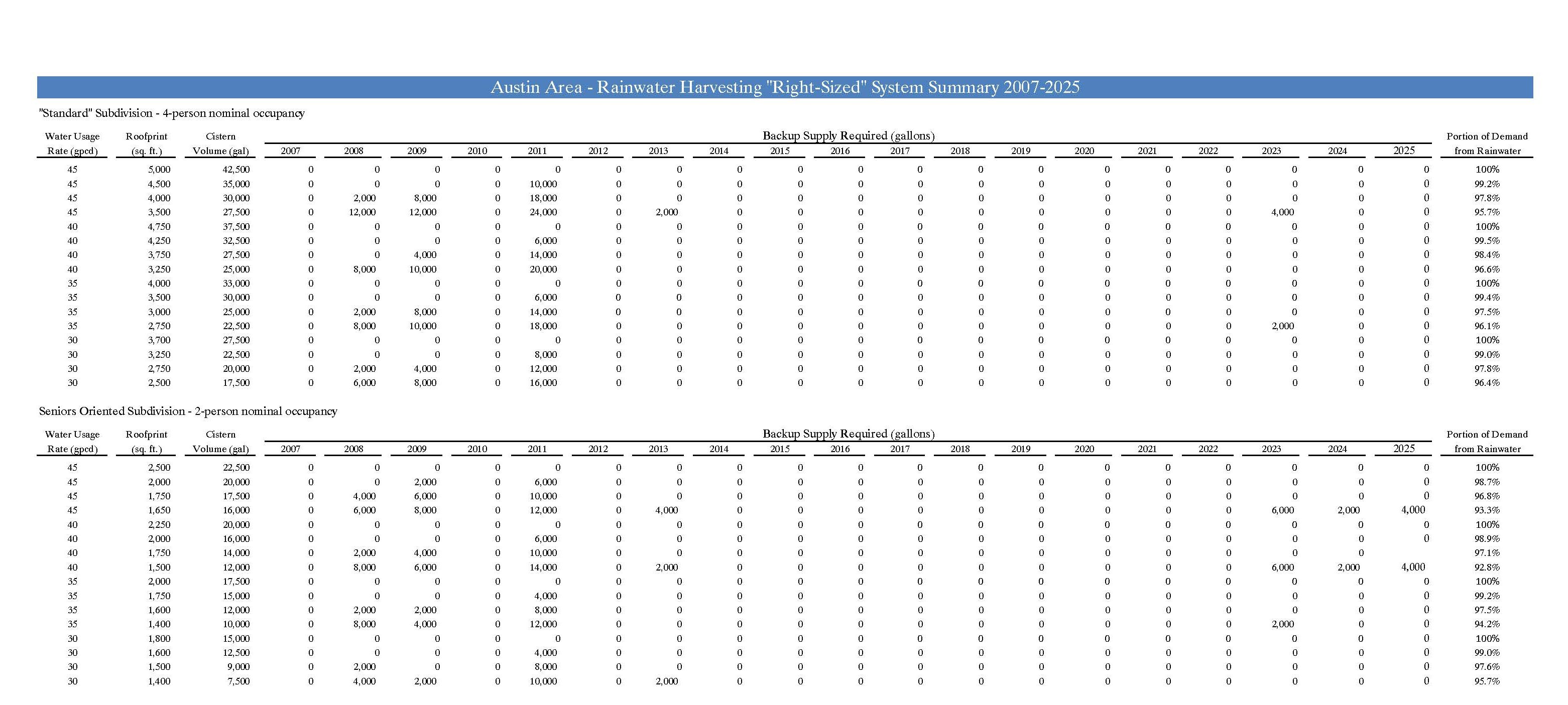
See the table in Figure 1 below showing the results of running the Rainwater Harvesting Model using Austin historic rainfalls. This indicates that, to support a family of 4, you’d want a roofprint of 3,500 sq. ft. This can be readily attained over a rather modest 3-bedroom house, as is shown in Figure 2. As that drawing shows, the water storage cistern can be designed into the house footprint, so not encumbering the area around each house with a free-standing cistern. You can see here that this water supply strategy could readily serve houses that could be “affordable”, if that’s the desired market. This strategy can serve such modest homes or high-end estates; it scales to either.

(click on image to enlarge)

In regard to cost, while of course the building-scale RWH facilities will add costs to each building, this strategy avoids costs for drilling wells or extending piped water to the development, and the costs of a distribution system within the development. There is also a “time value of money” savings, because while the conventional supply schemes would entail expenditures for permitting and for wells and pipelines well before the first building could be started, under the RWH strategy the water supply system for each building would incur no costs until that building is built. Likewise, this timing also minimizes the amount of money put “at risk”, since again there would be no up front money required; it is all expended as part and parcel of creating the revenue-producing components of the development, the buildings.

(click on image to enlarge)

As for the practicality of using RWH for water supply, the feasibility, workability and effectiveness of this strategy is demonstrated by the presence of thousands of houses using this strategy in Hays County alone. Indeed the Texas Region L 2026 Regional Water Plan stated there could be over 200,000 RWH systems in Hays County by 2080. So it is not at all a stretch to envision RWH as the water supply strategy over a whole development; this would just be catching a wave that is already swelling.

Note also the very circumstance that a large portion of the annual rainfall would be harvested and stored in the cistern, rather than running directly off the roofs. This imparts a hydrologic improvement over the conditions in a conventional development. You’re making that patch of ground, now covered by a building, perform hydrologically more like that patch in its native state. “Absorbing” the smaller rainfalls, producing runoff only from large storms or prolonged rainy periods. So besides avoiding the extraction and degradation of local water supplies, the RWH water supply strategy imparts a hydrologic improvement over conventional development, just as a matter of course.

Smart Wastewater Reuse and the OSSF Advantage

Wastewater management is centered on reusing this water resource to provide an irrigation water supply. With roof-harvested rainwater being dedicated to interior water usage, this reuse will allow for considerable irrigated landscaping without drawing on local groundwater or needing to expand roofprints to produce greater RWH supply. That’s the water resources reasoning for this strategy.

There are also cost reasons. Based on my 40 years of experience in this field, wastewater management in the hinterlands would be executed in the most cost efficient manner, while also best blunting environmental liabilities, by utilizing highly distributed systems, treating and reusing the wastewater close to where it is generated, so eliminating most of the collection system. Which in a conventional wastewater system composes 70-80% of total system cost. So big savings, simply by decentralizing.

But of course you’ve got to decentralize in an environmentally sound manner. The distributed systems employ “fail-safe” treatment units producing high quality effluent, and disperse that effluent in subsurface drip irrigation fields. The plants being irrigated would evapotranspirate most of that water, but what does percolate – some would over parts of the winter and during rainy periods any time of the year – that water would be well treated before it could join environmental waters, first by the treatment unit and then by percolation through the soil. So, quite environmentally sound.

Those distributed treatment units can be built quickly, reducing up front cost and time lag until the systems can come on line. Saving money. Drip irrigation maximizes irrigation efficiency while sequestering the water underground, so that grounds beautification up around the buildings – the landscaping likely to need irrigation – could be irrigated without hazard of contact with the effluent. So safely substituting reclaimed water for potable water, saving money.

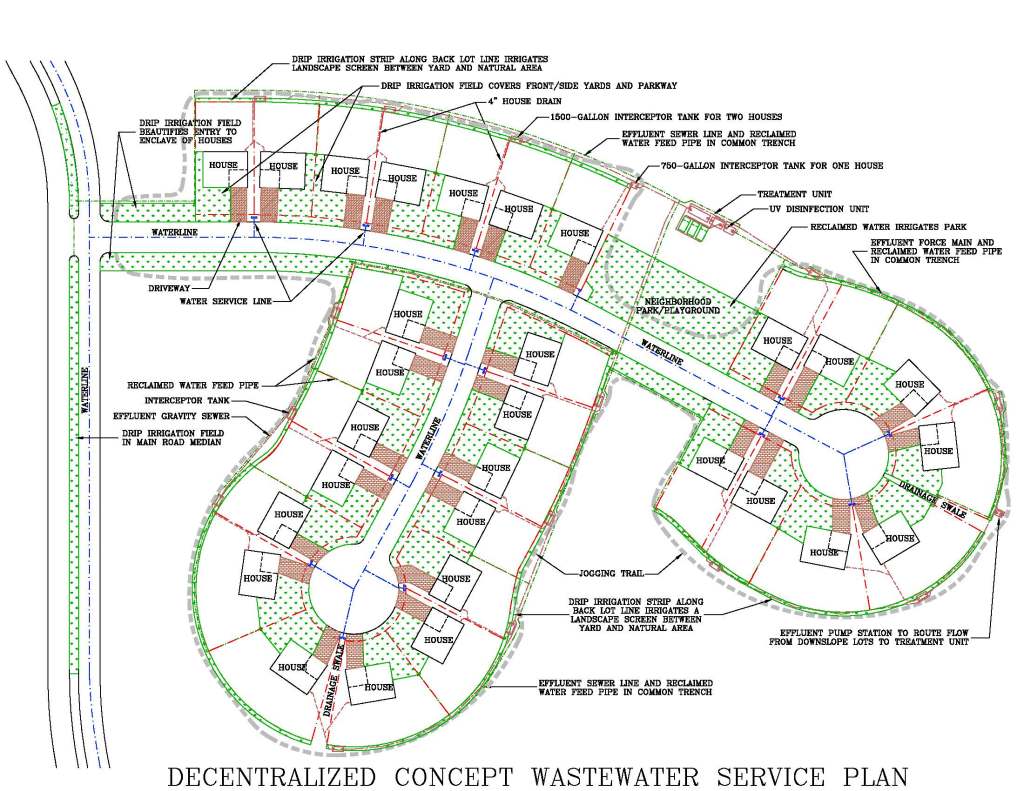
This “decentralized concept” strategy was explained more fully on the Waterblogue in “This is how we do it”, showing how this concept might be arrayed to serve houses on separate fee simple lots. Figure 3 shows how that scheme could be applied in a neighborhood of a Hill Country development. In that case, the wastewater system would have to be permitted at TCEQ under their “municipal” permitting program. The rules in Texas do not allow systems to be permitted under the on-site wastewater system rules – OSSFs in regulatory speak, standing for On-Site Sewage Facilities – if the buildings to be served lie on separate legal tracts. Even under this TCEQ permitting though, as reviewed in “This is how we do it”, it is expected that this sort of system would be more fiscally efficient, more societally responsible, and more environmentally benign than systems done in accord with conventional practice.

(click on image to enlarge)

If, however, a condominium ownership regime is deemed marketable, collective systems serving multiple buildings could be permitted under the OSSF rules. Same high quality systems, just a different permitting process. One that would significantly shorten the time line for approval and permitting – nominally 30 days, vs. a year or more under TCEQ permitting – and would avoid any delays due to protests of the permit, as OSSF permits are not subject to that. As time is money, shortening this timeline would save you money right there.

That same high quality system could be applied house by house, if your market were houses on larger fee simple lots. This sort of OSSF – high quality pretreatment and subsurface drip irrigation dispersal – has been permitted in Texas for 3 decades. An individual OSSF for each house, though the treatment unit is more costly per house than in a collective system, of course eliminates all collection system costs.

In any case, a collective distributed system – that would allow the houses to be clustered, so leaving more open space – would minimize money put in the ground just to move the stuff around, lowering total system cost. Most of the investment is focused on the real job to be done, providing high-quality treatment and beneficial reuse to impart environmentally sound management of this water resource.

Then too, an OSSF could be permitted and installed while the houses are being built. Again, the “time value of money”. And minimizing the money put at risk, not having to be expended well up front of the revenue-producing components of the development coming on line.

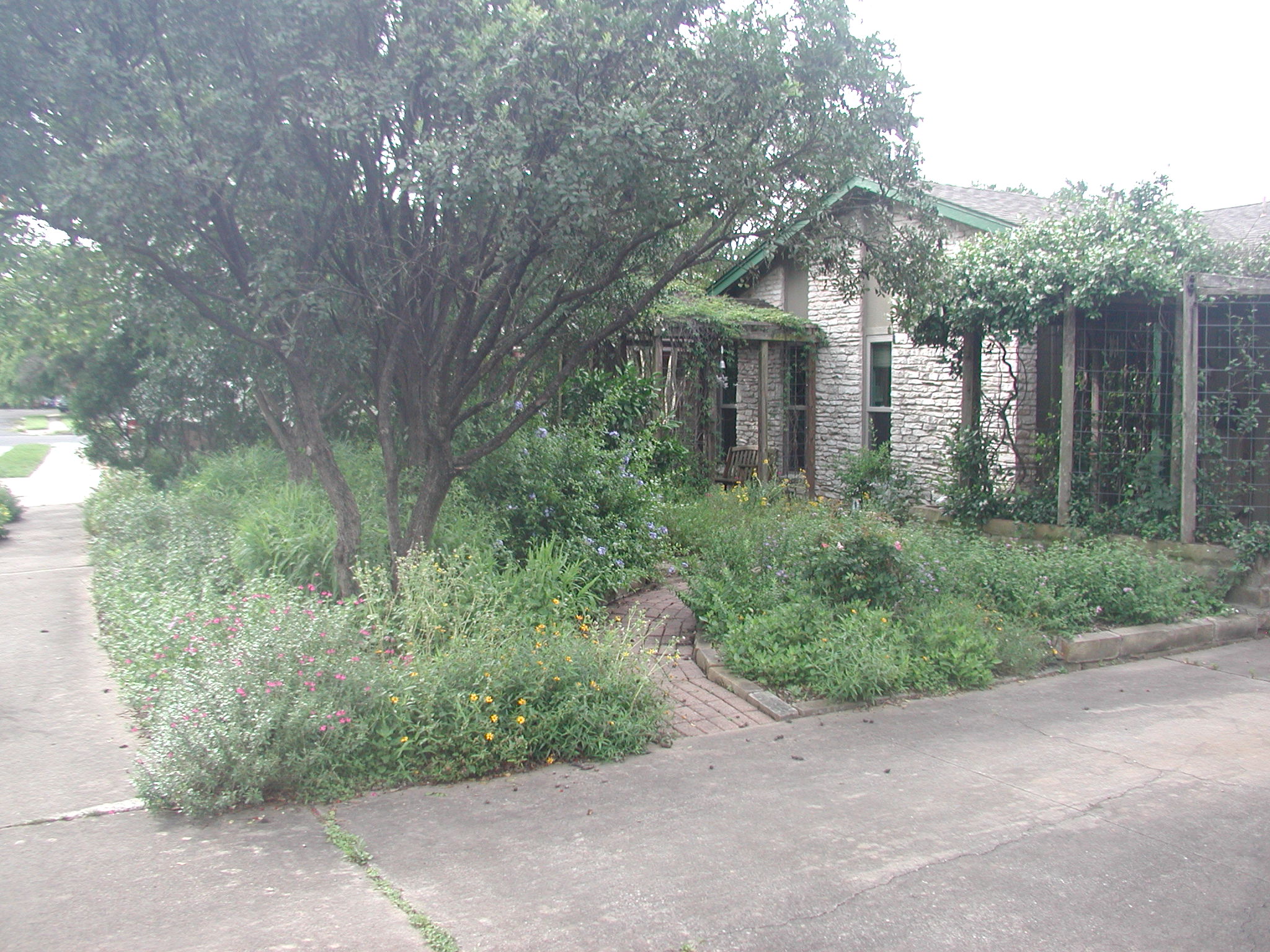
While the amount of water that would be obtained via wastewater reuse may be insufficient to keep a conventional landscape looking lush through the summer, a regionally appropriate landscape aesthetic could be quite well maintained on that supply. An example of a front yard landscaped with native plants is shown in Figure 4. Irrigating this landscape as part and parcel of the wastewater management system, rather than having to create a separate irrigation system, saves money.

Native Landscaped Front Yard
Figure 4

Employing that regionally appropriate landscaping aesthetic can help maintain a sense of place on the developed property. This would be the “face” of the development, a visual statement of sustainable water bona fides, adding intrinsic value to the clear functional role.

Stormwater Management as Land Restoration

While using RWH for water supply and a distributed, reuse-focused wastewater management strategy would “merely” blunt the extraction and degradation of water resources, it is in the arena of stormwater management that a development could really shine, actually imparting some hydrologic restoration of the site. Especially given that much of the land in this region has been degraded by past land use practices, such as historic over-grazing. So even a modicum of measures that would hold water on the land that would otherwise drain away might actually improve the site hydrology, somewhat restoring it to “native” condition even with some development being placed on the land.

The degree to which this might be attained would, of course, depend somewhat on the intensity of the development. In the sort of low-to-moderate density hinterlands development for which this water management scheme would be most applicable, it is expected that total impervious cover would be “low”. For example, in the proposed Hays County rules to govern “conservation development” – of which this “shining example” project could be an exponent – total impervious cover on the project would be limited to 20%. But even a typical exurban residential development would have a gross impervious cover level below 30%.

So there would be a lot of area available in a “shining example” development to house the stormwater retention facilities that would hold water on the land, and thus somewhat hydrologically restore previously degraded land, even as it is developed. The proof that these works could indeed restore the land is found in the work of Drought Proof Texas and Symbiosis, folks making a living doing this work for landowners, reflecting its value. A somewhat spectacular example of hydrologic restoration is Selah, the Bamberger Ranch, on which springs were restored! All this is accomplished with the sorts of landform alterations and plant choices to capture and insoak rainfall that would form the stormwater management strategy in a “shining example” project. Landform alterations, like rain gardens and bioswales, which themselves would be a part of the regionally appropriate landscaping aesthetic … that would not require irrigation.

Let’s Talk About Where to Go Next

This somewhat cursory overview of what would compose the “shining example” project needs of course to be further detailed, but the devil will always be in the details. So to get more specific, we really need to focus it on a specific piece of land. And on the landowner’s vision. If you are contemplating developing your land, and this more fiscally reasonable, more societally responsible, more environmentally benign way of development caters to your sensibilities, how about we talk? No obligations, just a conversation about how we create a “shining example”, how we may indeed develop our way toward sustainable water.

Can we develop our way to sustainable water?

May 11, 2026

Awhile back there was a “Daytripper” column in the Austin Chronicle about Jacob’s Well in Wimberley, Texas, which began with this:

“Jacob’s Well is dead. We are possibly the last generation to enjoy the cold water on a hot summer day of the iconic swimming hole outside of Wimberley.”

While I had been aware that Jacob’s Well has had low to no flow in the past few years, it was jarring to read it is dead! So I immediately wondered, what can be done to resuscitate it, to restore routine flow out of Jacob’s Well?

The fundamental fact of that whole region, which draws the vast majority of its water supply from the Trinity Aquifer – from which Jacob’s Well and other springs in the area derive – is that it’s “over” pumping from the aquifer that has lowered water levels and led to the dying of the springs. This impact has been exacerbated in the last few years by the enduring drought in this region; the average annual rainfalls have ranged several inches below the long-term average since the last “wet” year, in 2021.

Can We “Rehydrate” the Watershed?

But assuming for the moment pumping could be “adequately controlled”, it is quite possible to enhance recharge, and so better feed the springs, by how the land in the springshed is managed. I’ve long been aware of such practices from my permaculture training, and my awareness has been piqued recently by viewing the work of Symbiosis, LLC – a company that has been doing just that, seeking to cause more rainfall to insoak, and less to run off, to enhance productivity of the land – and by researching beaver mimicry (installing beaver dam analogs, or BDAs, in waterways) as measures to restore the hydrologic function of watersheds, enhancing recharge and stream baseflow.

So I reached out to the Watershed Association, the major NGO in the Wimberley Valley that deals with such environmental matters, and to The Meadows Center at Texas State University, a major center of thinking on all things sustainable water in this region, suggesting a program be created to “treat” land in the Jacob’s Well springshed. Highlighting the work of Symbiosis and examples of beaver mimicry, it was suggested that by applying such works at scale over the watershed, the level of recharge, and of stream baseflow, might indeed be enhanced over this area, better capturing and infiltrating whatever level of rainfall is received. So essentially “rehydrating” and “drought-proofing” the watershed.

We could perhaps start that process with a demonstration project on a portion of the watershed to show the efficacy of such a program, and then seek means of proliferating these measures. Perhaps by tapping into enlightened self-interest of landholders, noting that Symbiosis has shown that is already a market. Or by a program of land “preservation” through outright purchases and conservation easements – which is already being pursued, has been for some time, by the Watershed Association – and doing restoration works on those lands.

To “test” this idea, I ran the question by a couple AI chatbots of whether “treating” the watershed in such manners could indeed increase recharge, and so increase/enhance Jabob’s Well flow. Again, subject to also “properly controlling” pumping out of the aquifer, the ‘bots asserted that if applied at scale over the watershed, these could indeed be effective strategies. For example, one of them asserted, “Scientific models from the Hays-Trinity Groundwater Conservation District suggest that the springshed boundaries closely follow the Cypress Creek watershed. This means that land-based restoration specifically in this watershed has a direct, mechanical link to the flow at the Well.” And so, “Applying ‘permaculture-style’ treatments and Beaver Dam Analogs (BDAs) to the Cypress Creek watershed offers a high-prospect, though geologically complex, path to restoring Jacob’s Well.” I’ll leave further review of all that to other venues, because …

Still, It’s the Pumping … and the Growth

To pursue these strategies will require planning and marshaling public or institutional funding and the participation of a number of landowners. While we await any action toward such a program, I kept coming back to the need to “control” pumping out of the Trinity Aquifer. In particular over the Jacob’s Well springshed, which has been covered by the Jacob’s Well Groundwater Management Zone (JWGMZ), over which minimizing use of groundwater is a priority. Of course, pumping could be stemmed, at least blunting further increases, by simply not further developing in this area. But that runs headlong into the abiding issue that confronts the entire Texas Hill Country, the Wimberley Valley in particular, the tension between the state of water resources and people continuing to move there anyway.

This is well illustrated in a Wimberley Comprehensive Planning Process report in which it’s touted that “land conservation is water supply strategy”, urging land “preservation” – withholding it from development – on the principle that development would typically degrade the ability of the land to “absorb” water and so feed the aquifer. Cited as an example was the recent dedication of the Karst Canyon Preserve, relating that it is “176 acres adjacent to Jacob’s Well Natural Area, preserved through a decade of grassroots effort when it was slated for 1,600 homes”. The unasked, thus unanswered, question here is where would those 1,600 homes be built instead?

This is relevant because, besides being expensive to continue to “lock up” more land from development, consider that the basic purpose of that whole planning process is to be able to accommodate continued growth in the Wimberley Valley and environs. So if one displaces growth from one area, it must be accommodated somewhere else, if indeed growth is not to just stop altogether. Raising the basic question, can we essentially “preserve” the land, at least in terms of water yield management, as we develop to accommodate that growth? And if so, how?

So suggesting the proposition, if we follow the “right” practices, could we in essence develop our way to sustainable water, at least over an area like the JWGMZ?

As readers of the Waterblogue know, a suite of sustainable water development practices that could well deliver that outcome has been suggested – for example in “The Zero Net Water Concept”. It is argued that those practices would best protect water quality and other environmental values, including enhancing water yield out of a watershed, as the land is developed. This would be done by reducing supply drawn from aquifers and by holding more water on the land, to move through the hydrologic cycle as recharge or baseflow rather than as quickflow runoff. It is also suggested all that could be done while saving money for the developer.

A “Shining Example”

An overview of how those practices might be applied to development in hinterlands like the JWGMZ, to create development that would be a “shining example” of enlightened water management while also reducing fiscal risk and just flat saving money, is as follows:

  • Divide the land into lots upon which houses and/or commercial buildings would be owned under a condominium regime, with “airspace” ownership of the buildings and all the land owned in common by the condominium association. This would be done because …
  • Each lot would have the amount of development built upon it that would require a wastewater system with a design flow rate at or below 5,000 gallons/day. The condo arrangement could allow higher density than can typically be attained with individual on-site systems on separate lots, and would allow the buildings and pavement to be “clustered”, leaving more of the site undisturbed, so reducing land fragmentation. But most notably this arrangement would allow the wastewater systems to be permitted as OSSFs (On-Site Sewage Facilities, regulatory-speak for what are commonly called “septic systems”) by the local regulatory agent (county or river authority) instead of through the Texas Commission on Environmental Quality (TCEQ) “municipal system” permitting process.
  • This would shorten the timeline for approval of the wastewater system permit, typically to a couple months, as opposed to a year or more for the TCEQ process. The costs of permitting would be considerably reduced, and the OSSF permits would not be subject to formal protests and consequent public hearings, reducing risks of delay. Saving time, saving money.
  • Under this distributed management concept, the OSSF on each lot would not have to be planned, designed and built until buildings are to be built on that lot. The approval process for that OSSF could be completed while the buildings are being built, as could the installation, as these “small” systems could be built on a very short timeline. This delivers a “time value of money” by delaying these expenditures until they are actually needed to serve each “cluster” of development. Saving money.

An immediate question will be if wastewater management with OSSFs would provide the high level of environmental protection desired and expected in the JWGMZ watershed. Indeed, as envisioned here, they would provide a superior level of protection of water quality and other environmental values, because …

  • The wastewater systems would employ the highly robust, inherently stable and reliable High Performance Biofiltration Concept (recirculating packed-bed filter) treatment unit, producing a high quality effluent, including removing a majority of the nitrogen, a major pollutant of concern in groundwater recharge. The effluent would be dispersed in subsurface drip irrigation fields, where further nitrogen assimilation would occur via plant uptake and in-soil denitrification, and phosphorus would be completely assimilated. All done in a manner similar to what is illustrated in This is how we do it”. These technologies are widely known and understood in this field, and have been permitted many times in many Texas jurisdictions, so entail negligible regulatory risk.
  • Ideally the dispersal fields would be arrayed to irrigate the highest value landscaping on the lot, which would typically be grounds beautification around the buildings, so beneficially reusing this water resource to largely take irrigation off the potable water supply system, so saving that amount of water – pumpage out of the aquifer – day by day, year by year. Saving water, saving money.
  • With the reclaimed water flowing to the field every day without regard to the weather, clearly the drip irrigation field would have to act as a “drainfield” at times, like during rainy periods. That just means some of the water will exit the root zone by deep percolation rather than by evapotranspiration. Between the high quality pretreatment and passage through the soil, the minor fraction of annual flow that does percolate would be highly renovated before joining environmental waters.

If condominium ownership is deemed not suited to the target market, a conventionally lotted-out development could still be served by the same type of wastewater system, again as is illustrated in “This is how we do it”. The timeline and permitting costs would increase, but the same highly environmentally sound outcomes would be attained, as would the cost advantages of the distributed management concept.

Ideally the lots would be arranged so that each has frontage on/access to a public road, so that roads to the buildings would be private drives within the lots, rather than platted streets.

  • While these drives would still have to meet standards that would be imposed by the county in the platting process, like pavement quality and minimum widths and curve radii to accommodate fire trucks, all of these costs could be delayed until each lot is actually built upon, rather than having to all be on the ground over the whole subdivision at the outset to satisfy platting requirements, well before the first buildings could be built. This would also deliver a “time value of money” benefit. Saving money.
  • Here again, if condominium ownership is not desired, the project could still be developed with conventional lotting, with the drives being platted streets, “just” increasing costs some, not impacting on the water management benefits of the overall concept.

If there is not a waterline from a Public Water Supply System with sufficient capacity to serve the development close to the property, or if local groundwater does not have the capacity to support further development in the area – the situation over the JWGMZ – a reliable water supply can be provided by basing it on building-scale rainwater harvesting (RWH).

  • This would create a sustainable water supply system that would not draw down the local or regional water supplies, so would not negatively impact on the water environment, such as reducing springflows.
  • Under this strategy, costs would not be incurred to create the water supply for each building until that building is built, as the supply system would be part and parcel of the building construction. This would delay those costs until each building is built, so again delivering a “time value of money” benefit. Saving money.
  • For each building, it would be determined what the “right size” would be for the roofprint – the collection surface for the rainwater supply – and the storage cistern relative to the expected water demand in the building. A “right-sized” system would – based on modeling of an historic period that would cover a severe drought period – provide a large majority, typically 95% or more, of water usage over the modeling period. Water that would not have to be pumped out of the aquifer.
  • The needed roofprints could be provided with fairly “modest” house designs; this concept need not require “mansions” to make it viable. There are many examples of such RWH houses all throughout this region. Building designs can be derived that would most efficiently provide the needed roofprints, and could also incorporate the cisterns within or adjacent to the buildings, so not requiring free-standing cisterns to dot the landscape. A circumstance that some current HOAs deem an eyesore.
  • This overall strategy would include a plan for guaranteeing the provision of any backup supply that might be needed at any given building through a severe drought period.
  • With no wells or waterlines, fire protection would be addressed by installing dedicated fire suppression water tanks, to provide whatever amount of water is deemed to be needed in each situation.

Stormwater management would be centered on Low-Impact Development (LID) practices, most particularly “green infrastructure” such as rain gardens – engineered bioinfiltration or biofiltration basins – into which runoff from “developed” surfaces would be routed, for both water quality management and to provide some detention storage.

  • This basic stormwater management strategy essentially implements the Symbiosis-style “land treatment” – essentially permaculture practices – to enhance insoak and storage at the expense of quickflow runoff.
  • The overall system may also entail installing BDAs on any headwater draws within or bordering the site.
  • If building-scale RWH is the water supply strategy, the degree of rainwater collection off of the roofs would essentially take those impervious surfaces “out of play” in regard to water quality management, allowing rain gardens to be smaller, and leaving only whatever level of detention is deemed necessary for cistern and rain garden overflows. Saving money.
  • RWH would sequester water that would otherwise be direct runoff from the roofs, that would be covering a piece of land on which in its “native” state a large majority of annual rainfall would have infiltrated. That roof runoff is flow which, without RWH, would largely become quickflow runoff. This avoided runoff is transformed into 100% slow infiltration, once that harvested water, after being used for water supply in the building, becomes wastewater flow that is dispersed in drip irrigation fields.
  • If RWH were not used for the water supply, rainwater catchment off roofs could be used as the water quality management scheme, also integrating in storage to provide additional irrigation water supply around each building, in the manner illustrated in “… and Stormwater Too”. This could be part and parcel of strategies to take irrigation off the potable supply system, as was reviewed in this Waterblogue post, so relieving the aquifer of having to supply that water.
  • By these means, the stormwater management system would hold on the land at least as much rainfall as would infiltrate under “native” conditions. Indeed the amount held on the land could be increased, as is envisioned under the “land treatment” strategy, only allowing runoff to exit the site after the holding capacity of the LID installations were “filled”. This would maintain, indeed enhance, the hydrologic function of the site, making the rainfall-runoff response as “good as” or “better” than what occurred on the “native” site, despite having covered some of the site with impervious surfaces.
  • By a multiplicity of sites managed in this manner, the hydrologic integrity of watersheds could be maintained, indeed restored, so that the land would not be “desertified” by development, rather we’d be maintaining – or enhancing – stream baseflow and springflow in the watershed. In the JWGMZ and environs, over which some (much?) of the land has been hydrologically degraded by past land use practices, these practices would shift the balance to less quickflow runoff – the “flash” hydrology characteristic of Hill Country watersheds – and more insoak, that would become direct recharge or extended stream baseflow. Much of that baseflow may become recharge as it flows over recharge features in streambeds, past which much of the “flashy” runoff would rush.

The ‘bots Concur

I also ran this development model by the AI ‘bots, to get a read on whether it would be reasonable to expect that this sort of “hydrologically restorative” development strategy could indeed improve the water yield out of the watershed, in a manner similar to what the ‘bots asserted could be imparted by the various land treatments noted previously. The feedback was quite positive. Observations included:

  • To the basic question, can development practices meaningfully shift the balance toward recharge and away from water exiting the watershed via quickflow runoff, the answer was, yes, but only if the development is hydrologically regenerative rather than extractive. That is, developed under the model set forth above.
  • While “conventional” development typically exports water via centralized wastewater systems, greatly increases runoff, and increases groundwater extraction, this hydrologically regenerative development model blunts, or completely avoids, all that, through the practices reviewed above.
  • This is not water neutral, it is a positive addition to the water yield out of a watershed. We would be effectively “importing” water into the soil that would have otherwise been “lost” downstream.
  • This is the only development model that has any chance of being hydrologically restorative in a karst watershed.
  • 10-20% of the watershed developed this way would yield noticeable improvement in baseflow stability.
  • 30-40% adoption would yield a measureable shift in hydrograph shape and reduction of aquifer stress.
  • 50%+ adoption would plausibly deliver a system-level improvement in spring persistence.

The Pushback

There would likely be some consternation among the environmental advocacy community about developing a significant portion of the JWGMZ watershed, but it must be kept in mind that this development entails a degree of land restoration. It might be questioned how valuable it would be to simply “preserve” land that is hydrologically degraded, vs. to develop it under the hydrologically restorative model. And it’s likely to be some time before a significant portion of the watershed would be developed, allowing opportunity to assess the actual impacts, and to adjust the aims and expectations as found to be relevant.

In any case, recalling how this whole discussion started, if any significant portion of the watershed were to be “treated” to enhance insoak as general land management practice, a high-level impact may be attained while actively developing less of the watershed. Bottom line, the overall prospects for positive outcomes appear high.

Though the benefits could be significant, there would be a high hurdle to be surmounted to move practice to this model. As the ‘bot stated it, the obstacles are not hydrologic, they are:

  • Regulatory
  • Cultural
  • Developer inertia
  • Financing norms
  • Utility business models
  • County level governance structures

This model threatens:

  • Centralized utilities
  • Engineering firms
  • Revenue streams
  • The “standard practice” template

It is noted that this whole way of proceeding is not exactly new. The suite of strategies set forth above is the same basic “prescription” suggested a couple years ago for the Hays Commons project on the outskirts of Austin in “Moving off top dead center”, to mitigate a development over the Edwards Aquifer Recharge Zone in which the water environment is about to be significantly degraded by applying the “once-through” conventional water management practices. And really also for Mirasol Springs in “If you’re going to call it a vision …”. Indeed, some variant of all this has been set forth as a template for water management on developments for over 2 decades, and the wastewater management aspects of it for over 4 decades.

This is noted simply to highlight that those practices still sit largely idle because those barriers the ‘bot listed do indeed pose a huge hurdle. This is all disruptive to entrenched interests and therefore has been, and will continue to be, difficult to navigate through the objections of “the system”. Indeed, that history shows it seems unlikely that one could navigate through it at all, so one will have to go around it, to put a “shining example” project on the ground that proves the concept would deliver on its promises. But none of that changes the hydrology, the ‘bot stressed, it only changes the adoption curve.

On the plus side of all this, Hays County is in the process of bolstering its “conservation development” standards, and communications to date indicate that the water management strategies set forth above are generally what they have in mind as features of conservation developments. As the basic development scheme needs only plat approval and an OSSF permit from the county, it is not expected that the proposed “shining example” project would encounter regulatory pushback.

What Does It Cost?

Now of course folks will ask what it would cost to conserve land in this manner. We should look at that in light of the overall aim to “preserve” this watershed. The land can of course be put off limits to development so as to retain its positive water management properties, like was touted for Karst Canyon Preserve, or it can be conserved in regard to water yield management by developing in this hydrologically restorative manner. The former would cost money, the latter would make money. So on a purely fiscal evaluation, this is a no-brainer; conservation development wins hands down. Recognizing of course the value of open space to people, so it is not suggested that all land “preservation” be abandoned, but clearly there is an opportunity to hydrologically conserve far more land, funded by the private sector, than we could ever afford to buy for open space dedication.

The real cost question is what is the actual cost efficiency of developing in this manner. Or maybe stated in developer-speak, whether the unit yield relative to the cost would make this model appear to them to be a good deal, the money-saver that it’s asserted above it would be. Land price would of course be a big part of that. The more expensive the land, the greater the unit yield must be, or maybe the higher-dollar the properties must be, for the project to “pencil out”. So could this development model deliver “enough” units? We’ll come to understand how that works out when we do put a project on the ground.

The Road Not Taken …

It remains to find the landowner who sees the value in this manner of proceeding, who embraces the land ethic, who wants to leave a land legacy, improving rather than degrading the watershed. A landowner who would choose to develop in this hydrologically regenerative manner, who wants to be the one to set forth the “shining example” project … and maybe break the dam and start us down the road to sustainable water.